Making Perfect Landings In Light Airplanes Pdf Download UPDATED
Making Perfect Landings In Light Airplanes Pdf Download

Landing gear is the undercarriage of an shipping or spacecraft and may be used for either takeoff or landing. For aircraft it is generally needed for both. It was as well formerly called alighting gear by some manufacturers, such as the Glenn Fifty. Martin Company. For aircraft, Stinton[1] makes the terminology distinction undercarriage (British) = landing gear (US).
For shipping, the landing gear supports the craft when information technology is not flying, allowing it to take off, country, and taxi without harm. Wheeled landing gear is the well-nigh mutual, with skis or floats needed to operate from snow/water ice/water and skids for vertical functioning on country. Faster aircraft accept retractable undercarriages, which fold away during flight to reduce drag.
Some unusual landing gear have been evaluated experimentally. These include: no landing gear (to relieve weight), fabricated possible by operating from a catapult cradle and flexible landing deck:[2] air cushion (to enable performance over a wide range of ground obstacles and water/snow/ice);[3] tracked (to reduce rail loading).[iv]
For launch vehicles and spacecraft landers, the landing gear usually only supports the vehicle on landing, and is not used for takeoff or surface move.
Given their varied designs and applications, there exists dozens of specialized landing gear manufacturers. The three largest are Safran Landing Systems, Collins Aerospace (part of Raytheon Technologies) and Héroux-Devtek.
Aircraft [edit]
The landing gear represents ii.5 to 5% of the maximum takeoff weight (MTOW) and one.5 to 1.75% of the shipping toll, but 20% of the airframe directly maintenance cost. A suitably-designed bicycle can back up 30 t (66,000 lb), tolerate a ground speed of 300 km/h and roll a distance of 500,000 km (310,000 mi) ; information technology has a 20,000 hours fourth dimension betwixt overhaul and a 60,000 hours or 20 years life time.[5]
Gear arrangements [edit]
- Airplanes
-

-
-

Wheeled undercarriages unremarkably come in two types:
- Conventional landing gear or "taildragger", where there are two main wheels towards the front of the aircraft and a unmarried, much smaller, wheel or skid at the rear. The same helicopter arrangement is called tricycle tailwheel.[6]
- Tricycle undercarriage where there are ii main wheels (or cycle assemblies) nether the wings and a tertiary smaller wheel in the olfactory organ. The same helicopter organisation is called tricycle nosewheel.
The taildragger arrangement was mutual during the early propeller era, as it allows more room for propeller clearance. Most modern aircraft have tricycle undercarriages. Taildraggers are considered harder to state and take off (considering the arrangement is usually unstable, that is, a small deviation from direct-line travel will tend to increase rather than correct itself), and usually require special airplane pilot training. A small tail wheel or sideslip/bumper may be added to a tricycle undercarriage to prevent damage to the underside of the fuselage if over-rotation occurs on accept-off leading to a tail strike. Aircraft with tail-strike protection include the B-29 Superfortress, Boeing 727 trijet and Concorde. Some aircraft with retractable conventional landing gear have a stock-still tailwheel. Hoerner[seven] estimated the elevate of the Bf 109 fixed tailwheel and compared it with that of other protrusions such as the pilot's canopy.
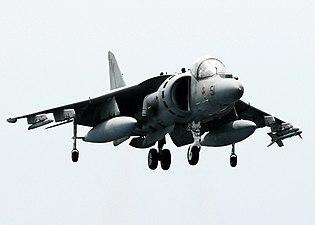
A third system (known equally tandem or bicycle) has the main and nose gear located fore and aft of the center of gravity under the fuselage with outriggers on the wings. This is used when there is no user-friendly location on either side of the fuselage to adhere the main undercarriage or to store it when retracted. Examples include the Lockheed U-two spy airplane and the Harrier Jump Jet. The Boeing B-52 uses a similar arrangement, except that the fore and aft gears each have two twin-wheel units side past side.
Quadricycle gear is similar to bicycle merely with two sets of wheels displaced laterally in the fore and aft positions. Raymer[eight] classifies the B-52 gear as quadricycle. The experimental Fairchild Xc-120 Packplane had quadricycle gear located in the engine nacelles to allow unrestricted access beneath the fuselage for attaching a large freight container.[9]
Helicopters use skids, pontoons or wheels depending on their size and office.
- Helicopters
-

Retractable gear [edit]
Retraction of the landing gear of a Boeing 727 after take-off
To decrease drag in flight undercarriages retract into the wings and/or fuselage with wheels affluent with the surrounding surface or concealed backside flush-mounted doors; this is chosen retractable gear. If the wheels don't retract completely but beetle partially exposed to the airstream, information technology is chosen a semi-retractable gear.
Most retractable gear is hydraulically operated, though some is electrically operated or even manually operated on very light aircraft. The landing gear is stowed in a compartment called a wheel well.
Pilots confirming that their landing gear is down and locked refer to "three greens" or "three in the greenish.", a reference to the electrical indicator lights (or painted panels of mechanical indicator units) from the nosewheel/tailwheel and the two main gears. Blinking green lights or scarlet lights bespeak the gear is in transit and neither up and locked or down and locked. When the gear is fully stowed up with the upwardly-locks secure, the lights oftentimes extinguish to follow the nighttime cockpit philosophy; some airplanes take gear upwardly indicator lights.[ten]
Redundant systems are used to operate the landing gear and redundant main gear legs may besides exist provided and so the aircraft can be landed in a satisfactory manner in a range of failure scenarios. The Boeing 747 was given 4 split and independent hydraulic systems (when previous airliners had two) and iv chief landing gear posts (when previous airliners had two). Safe landing would be possible if two chief gear legs were torn off provided they were on opposite sides of the fuselage.[11] In the case of power failure in a light aircraft, an emergency extension organization is ever available. This may exist a manually operated crank or pump, or a mechanical costless-autumn mechanism which disengages the uplocks and allows the landing gear to fall under gravity.
-

Retractable landing gear animation
Shock absorbers [edit]
Shipping landing gear includes wheels equipped with solid shock absorbers on light planes, and air/oil oleo struts on larger shipping.
-

Oleo strut (pressurized gas or oil) with torque links
-

Oleo strut with trailing link
-

Condom discs in compression with trailing link of a Mooney M20
-
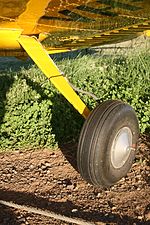
Simple spring steel bar, used on many light shipping
-

Simple steel tube
Big aircraft [edit]
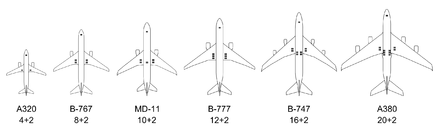
Wheel arrangements of large airliners
As aircraft weights have increased more than wheels have been added and runway thickness has increased to proceed inside the rail loading limit. The Zeppelin-Staaken R.Half-dozen, a large High german World War I long-range bomber of 1916, used eighteen wheels for its undercarriage, split between two wheels on its olfactory organ gear struts, and sixteen wheels on its main gear units—split into iv side-by-side quartets each, 2 quartets of wheels per side—under each tandem engine nacelle, to support its loaded weight of about 12 t (26,000 lb).
Multiple "tandem wheels" on an aircraft—especially for cargo aircraft, mounted to the fuselage lower sides as retractable main gear units on modern designs—were get-go seen during World State of war Ii, on the experimental High german Arado Ar 232 cargo aircraft, which used a row of 11 "twinned" fixed wheel sets straight under the fuselage centerline to handle heavier loads while on the ground.[12] Many of today's large cargo aircraft utilize this arrangement for their retractable main gear setups, commonly mounted on the lower corners of the cardinal fuselage construction.
The prototype Convair XB-36 had nearly of its weight on two main wheels, which needed runways at least 22 in (56 cm) thick. Product aircraft used two four-cycle bogies, allowing the aircraft to use any airfield suitable for a B-29.[13]
A relatively calorie-free Lockheed JetStar business jet, with four wheels supporting 44,000 lb (20 t), needed a x in (25 cm) thick flexible asphalt pavement. The 210,000 lb (95 t) Boeing 727-200 with 4 tires on two legs main landing gears required a 20 in (51 cm) thick pavement. The thickness rose to 25 in (64 cm) for a McDonnell Douglas DC-x-ten with 443,000 lb (201 t) supported on eight wheels on ii legs. The heavier, 558,000 lb (253 t), DC-ten-30/forty were able to operate from the same thickness pavements with a third main leg for ten wheels, similar the outset Boeing 747-100, weighing 700,000 lb (320 t) on four legs and 16 wheels. The similar-weight Lockheed C-5, with 24 wheels, needs an 18 in (46 cm) pavement.[14]
The twin-wheel unit on the fuselage centerline of the McDonnell Douglas DC-10-30/40 was retained on the Doc-eleven airliner and the same configuration was used on the initial 275 t (606,000 lb) Airbus A340-200/300, which evolved in a complete four-bike undercarriage bogie for the heavier 380 t (840,000 lb) Airbus A340-500/-600.[15] [16] The up to 775,000 lb (352 t) Boeing 777 has twelve main wheels on two three-axles bogies, like the after Airbus A350.
The 575 t (1,268,000 lb) Airbus A380 has a four-cycle bogie under each wing with 2 sets of six-wheel bogies under the fuselage.[17] The 640 t (1,410,000 lb) Antonov An-225, the largest cargo shipping, has four wheels on the twin-strut nose gear units like the smaller Antonov An-124, and 28 main gear wheels.[eighteen]
The 97 t (214,000 lb) A321neo has a twin-bike main gear inflated to 15.seven bar (228 psi),[19] while the 280 t (620,000 lb) A350-900 has a iv-wheel main gear inflated to 17.1 bar (248 psi).[20]
-

Wing and fuselage undercarriages on a Boeing 747-400, shortly before landing
STOL aircraft [edit]
STOL aircraft have a college sink-charge per unit requirement if a carrier-type, no-flare landing technique has to exist adopted to reduce touchdown scatter. For example, the Saab 37 Viggen, with landing gear designed for a 5m/sec affect, could utilize a carrier-type landing and HUD to reduce its scatter from 300 m to 100m.[21]
The de Havilland Canada DHC-4 Caribou used long-stroke legs to land from a steep arroyo with no float.[22]
Operation from water [edit]
A flight boat has a lower fuselage with the shape of a boat hull giving information technology buoyancy. Fly-mounted floats or stubby wing-similar sponsons are added for stability. Sponsons are attached to the lower sides of the fuselage.
A floatplane has two or three streamlined floats. Amphibious floats accept retractable wheels for land operation.
An amphibious aircraft or amphibian usually has two distinct landing gears, namely a "boat" hull/floats and retractable wheels, which allow information technology to operate from land or water.
Beaching gear is detachable wheeled landing gear that allows a not-amphibious floatplane or flying boat to be maneuvered on country. It is used for aircraft maintenance and storage and is either carried in the aircraft or kept at a slipway. Beaching gear may consist of individual detachable wheels or a cradle that supports the entire aircraft. In the one-time instance, the beaching gear is manually attached or detached with the shipping in the h2o; in the latter case, the aircraft is maneuvered onto the cradle.
Helicopters are able to land on water using floats or a hull and floats.
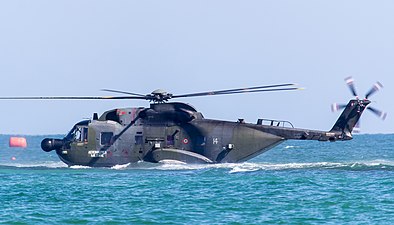
For take-off a step and planing bottom are required to lift from the floating position to planing on the surface. For landing a cleaving action is required to reduce the touch on with the surface of the water. A vee bottom parts the water and chines deflect the spray to forbid it damaging vulnerable parts of the aircraft. Additional spray control may exist needed using spray strips or inverted gutters. A step is added to the hull, only behind the center of gravity, to stop h2o clinging to the afterbody and then the aircraft can advance to flying speed. The step allows air, known every bit ventilation air, to pause the water suction on the afterbody.[23] Ii steps were used on the Kawanishi H8K.[24] A step increases the elevate in flying. The drag contribution from the pace can exist reduced with a fairing. A faired pace was introduced on the Short SunderlandIII.[25]
Ane goal of seaplane designers was the evolution of an open up bounding main seaplane capable of routine operation from very rough water. This led to changes in seaplane hull configuration. High length/beam ratio hulls and extended afterbodies improved crude water capabilities.[26] A hull much longer than its width also reduced elevate in flying.[27] An experimental development of the Martin Marlin, the Martin Chiliad-270, was tested with a new hull with a greater length/axle ratio of fifteen obtained past adding 6 anxiety to both the nose and tail.[27] Crude-sea capability tin can exist improved with lower accept-off and landing speeds because impacts with waves are reduced. The Shin Meiwa US-1A is a STOL amphibian with blown flaps and all control surfaces. The ability to land and take-off at relatively low speeds of about 45 knots and the hydrodynamic features of the hull, long length/beam ratio[28] and inverted spray gutter for case, permit functioning in wave heights of xv feet.[29] The inverted gutters aqueduct spray to the rear of the propeller discs.[30]
Low speed maneuvring is necessary betwixt slipways and buoys and take-off and landing areas. H2o rudders are used on seaplanes ranging in size from the Democracy RC-3 Seabee to the Beriev A-40[31] Hydro flaps were used on the Martin Marlin[32] and Martin SeaMaster. Hydroflaps, submerged at the rear of the afterbody, act as a speed restriction or differentially every bit a rudder. A fixed fin, known as a skeg, has been used for directional stability. A skeg, was added to the 2d step on the Kawanishi H8K flying boat hull.[33]
High speed impacts in rough water between the hull and moving ridge flanks may be reduced using hydro-skis which agree the hull out of the water at college speeds. Hydro skis replace the need for a boat hull and just require a plainly fuselage which planes at the rear. Alternatively skis with wheels tin be used for land-based aircraft which first and end their flight from a beach or floating barge. Hydro-skis with wheels were demonstrated as an all-purpose landing gear conversion of the Fairchild C-123, known as the Panto-base[34] Stroukoff YC-134. A seaplane designed from the outset with hydro-skis was the Convair F2Y Body of water Sprint prototype fighter. The skis incorporated small wheels, with a third cycle on the fuselage, for ground handling.
In the 1950s hydro-skis were envisaged as a ditching aid for big piston-engined aircraft.[35] Water-tank tests washed using models of the Lockheed Constellation, Douglas DC-4 and Lockheed Neptune concluded that chances of survival and rescue would be greatly enhanced past preventing critical damage associated with ditching.[36]
-

Kawanishi H8K showing two steps on the hull, a skeg at the second step and spray strips under the forebody
-
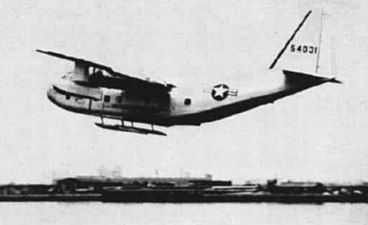
Stroukoff YC-123E showing hydro-skis on pantobase landing gear
Shipboard operation [edit]
The landing gear on fixed-fly aircraft that land on aircraft carriers have a higher sink-rate requirement because the shipping are flown onto the deck with no landing flare. Other features are related to catapult have-off requirements for specific aircraft. For example, the Blackburn Buccaneer was pulled downwards onto its tail-sideslip to prepare the required nose-upward attitude. The naval McDonnell Douglas F-iv Phantom II in UK service needed an extending nosewheel leg to set the wing attitude at launch.[37]
The landing gear for an aircraft using a ski-leap on take-off is subjected to loads of 0.5g which likewise last for much longer than a landing impact.[38]
Helicopters may have a deck-lock harpoon to anchor them to the deck.[39]
In-flight utilise [edit]
Some shipping have a requirement to use the landing-gear as a speed restriction.
Flexible mounting of the stowed main landing-gear bogies on the Tupolev Tu-22R raised the aircraft flutter speed to 550 kts. The bogies oscillated within the nacelle under the control of dampers and springs as an anti-flutter device.[xl]
Gear mutual to unlike shipping [edit]
Some experimental shipping accept used gear from existing shipping to reduce program costs. The Martin-Marietta X-24 lifting body used the nose/main gear from the North American T-39 / Northrop T-38 and the Grumman X-29 from the Northrop F-v / General Dynamics F-16.[41]
Other types [edit]
Skis [edit]

When an airplane needs to country on surfaces covered by snow, the landing gear normally consists of skis or a combination of wheels and skis.
Detachable [edit]

Me 163B Komet with its two-wheel takeoff "dolly" in place
Some aircraft employ wheels for takeoff and jettison them when airborne for improved streamlining without the complication, weight and space requirements of a retraction mechanism. The wheels are sometimes mounted onto axles that are part of a split "dolly" (for principal wheels only) or "trolley" (for a three-wheel set with a nosewheel) chassis. Landing is done on skids or like simple devices.
Historical examples include the "dolly"-using Messerschmitt Me 163 Komet rocket fighter,[42] the Messerschmitt Me 321 Gigant troop glider, and the outset viii "trolley"-using prototypes[43] of the Arado Ar 234 jet reconnaissance bomber. The main disadvantage to using the takeoff dolly/trolley and landing skid(s) system on High german Globe State of war Two aircraft – intended for a sizable number of late-war German jet and rocket-powered armed forces shipping designs – was that aircraft would likely be scattered all over a military airfield afterward they had landed from a mission, and would be unable to taxi on their own to an accordingly hidden "dispersal" location, which could easily exit them vulnerable to existence shot upward by attacking Centrolineal fighters. A related contemporary example are the wingtip support wheels ("pogos") on the Lockheed U-2 reconnaissance aircraft, which fall away afterward take-off and drop to earth; the aircraft then relies on titanium skids on the wingtips for landing.[ citation needed ]
Rearwards and sideways retraction [edit]
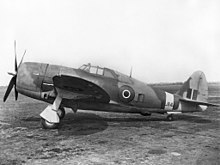
A Regal Air Force P-47 with its raked-forward master gear, and rearward-angled chief bicycle position (when retracted) indicated past the simply-visible open up cycle door.
Some main landing gear struts on Globe War Ii shipping, in gild to allow a single-leg master gear to more than efficiently store the wheel inside either the wing or an engine nacelle, rotated the single gear strut through a 90° angle during the rearwards-retraction sequence to allow the main bike to residual "flat" above the lower end of the main gear strut, or flush inside the wing or engine nacelles, when fully retracted. Examples are the Curtiss P-40, Vought F4U Corsair, Grumman F6F Hellcat, Messerschmitt Me 210 and Junkers Ju 88. The Aero Commander family of twin-engined business shipping also shares this feature on the primary gears, which retract aft into the ends of the engine nacelles. The rearward-retracting nosewheel strut on the Heinkel He 219[44] and the forward-retracting nose gear strut on the later Cessna Skymaster similarly rotated 90 degrees as they retracted.[ commendation needed ]
On most Globe State of war 2 single-engined fighter shipping (and even one German heavy bomber design) with sideways retracting principal gear, the master gear that retracted into the wings was raked forwards in the "down" position for better ground handling, with a retracted position that placed the main wheels at some altitude aft of their position when downairframe – this led to a circuitous angular geometry for setting up the "pintle" angles at the pinnacle ends of the struts for the retraction mechanism's centrality of rotation. with some aircraft, like the P-47 Thunderbolt and Grumman Bearcat, even mandating that the main gear struts diffuse as they were extended to give sufficient ground clearance for their large 4-bladed propellers. One exception to the need for this complexity in many WW 2 fighter aircraft was Japan'southward famous Zero fighter, whose primary gear stayed at a perpendicular angle to the centerline of the aircraft when extended, as seen from the side.
Variable axial position of master wheels [edit]
The main wheels on the Vought F7U Cutlass could move twenty inches between a forward and aft position. The forward position was used for have-off to give a longer lever-arm for pitch control and greater nose-up attitude. The aft position was used to reduce landing bounce and reduce run a risk of tip-back during ground handling.[45]
Tandem layout [edit]
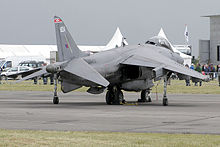
The tandem or bicycle layout is used on the Hawker Siddeley Harrier, which has two principal-wheels behind a single olfactory organ-wheel under the fuselage and a smaller cycle almost the tip of each fly. On second generation Harriers, the fly is extended past the outrigger wheels to allow greater wing-mounted munition loads to be carried, or to permit wing-tip extensions to be bolted on for ferry flights.[46]
A tandem layout was evaluated by Martin using a specially-modified Martin B-26 Marauder (the XB-26H) to evaluate its use on Martin's start jet bomber, the Martin XB-48. This configuration proved so manoeuvrable that it was also selected for the B-47 Stratojet.[47] It was also used on the U-2, Myasishchev M-4, Yakovlev Yak-25, Yak-28, Sud Aviation Vautour. A variation of the multi tandem layout is also used on the B-52 Stratofortress which has four main cycle bogies (two forrard and 2 aft) underneath the fuselage and a small outrigger wheel supporting each wing-tip. The B-52's landing gear is also unique in that all 4 pairs of main wheels tin be steered. This allows the landing gear to line upwardly with the rail and thus makes crosswind landings easier (using a technique called crab landing). Since tandem shipping cannot rotate for takeoff, the forrad gear must be long enough to give the wings the correct angle of assault during takeoff. During landing, the forward gear must non touch the rails first, otherwise the rear gear will slam down and may crusade the shipping to bounce and go airborne once again.[48]
Crosswind landing accommodation [edit]

The "castoring" master gear arrangement on a Blériot XI
One very early undercarriage incorporating castoring for crosswind landings was pioneered on the Bleriot VIII design of 1908. Information technology was subsequently used in the much more famous Blériot XI Channel-crossing aircraft of 1909 and also copied in the primeval examples of the Etrich Taube. In this arrangement the main landing gear'south shock absorption was taken upward by a vertically sliding bungee cord-sprung upper member. The vertical post along which the upper member slid to accept landing shocks also had its lower end as the rotation bespeak for the frontward end of the master wheel's pause fork, allowing the main gear to pivot on moderate crosswind landings.[ citation needed ]
Manually-adapted main-gear units on the B-52 can be set for crosswind have-offs. It rarely has to exist used from SAC-designated airfields which take major runways in the predominant strongest wind management.[49] The Lockheed C-5 Galaxy has swivelling half dozen-wheel main units for crosswind landings and castoring rear units to preclude tire scrubbing on tight turns.[l]
"Kneeling" gear [edit]
Both the nosegear and the wing-mounted master landing gear of the Earth War Ii German language Arado Ar 232 cargo/transport aircraft were designed to kneel. This made it easier to load and unload cargo, and improved taxiing over ditches and on soft footing.[51]
Some early on U.S. Navy jet fighters were equipped with "kneeling" nose gear consisting of small steerable auxiliary wheels on short struts located forward of the primary nose gear, allowing the aircraft to be taxied tail-high with the primary nose gear retracted. This feature was intended to enhance safety aboard aircraft carriers by redirecting the hot exhaust blast upward, and to reduce hangar space requirements by enabling the aircraft to park with its nose underneath the tail of a similarly equipped jet. Kneeling gear was used on the North American FJ-one Fury[52] and on early on versions of the McDonnell F2H Banshee, merely was found to exist of picayune use operationally, and was omitted from later Navy fighters.[53]
The nosewheel on the Lockheed C-5,[54] partially retracts against a bumper to help in loading and unloading of cargo using ramps through the forward, "tilt-up" hinged fuselage nose while stationary on the ground. The aircraft likewise tilts backwards.[55] The Messier twin-bike main units fitted to the Transall and other cargo aircraft can tilt forward or backward as necessary.[56]
The Boeing AH-64 Apache helicopter is able to kneel to fit inside the cargo hold of a ship shipping and for storage.[57]
Tail support [edit]
Aircraft landing gear includes devices to prevent fuselage contact with the ground by tipping back when the shipping is existence loaded. Some commercial aircraft accept used tail props when parked at the gate.[58] The Douglas C-54 had a critical CG location which required a ground treatment strut.[59] The Lockheed C-130 and Boeing C-17 Globemaster III utilize ramp supports.[60]
Monowheel [edit]

To minimize drag, modern gliders usually have a single wheel, retractable or stock-still, centered under the fuselage, which is referred to as monowheel gear or monowheel landing gear. Monowheel gear is too used on some powered aircraft, where drag reduction is a priority, such as the Europa Archetype. Much like the Me 163 rocket fighter, some gliders from prior to the 2d World War used a take-off dolly that was jettisoned on take-off; these gliders and then landed on a fixed slip.[61] This configuration is necessarily accompanied with a taildragger.
Helicopters [edit]
Light helicopters use simple landing skids to save weight and cost. The skids may accept zipper points for wheels so that they tin can be moved for brusk distances on the ground. Skids are impractical for helicopters weighing more iv tons. Some high-speed machines accept retractable wheels, but almost use stock-still wheels for their robustness, and to avert the need for a retraction mechanism.[62]
Tailsitter [edit]
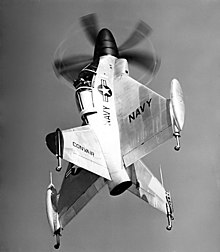
Experimental tailsitter aircraft use landing gear located in their tails for VTOL operation.
Light aircraft [edit]
For light aircraft a blazon of landing gear which is economical to produce is a simple wooden arch laminated from ash, as used on some homebuilt aircraft. A similar arched gear is often formed from jump steel. The Cessna Airmaster was amidst the first shipping to apply leap steel landing gear. The main advantage of such gear is that no other shock-absorbing device is needed; the deflecting leafage provides the shock absorption.[ citation needed ]
Folding gear [edit]
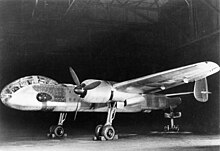
Ju 288 V1 first prototype, showing its complex "folding" main undercarriage.
The express space bachelor to stow landing gear has led to many complex retraction mechanisms, each unique to a particular aircraft. An early example, the German Bomber B gainsay aircraft design contest winner, the Junkers Ju 288, had a complex "folding" main landing gear unlike any other aircraft designed past either Axis or Allied sides in the war: its unmarried oleo strut was but fastened to the lower cease of its Y-course main retraction struts, handling the twinned primary gear wheels, and folding by swiveling downwards and aftwards during retraction[63] to "fold" the maingear'due south length to shorten it for stowage in the engine nacelle it was mounted in.[64] Nonetheless, the single pin-point pattern also led to numerous incidents of collapsed maingear units for its paradigm airframes.
Tracked [edit]
Increased contact area tin be obtained with very big wheels, many smaller wheels or rail-type gear. Tracked gear fabricated by Dowty was fitted to a Westland Lysander in 1938 for taxi tests, so a Fairchild Cornell and a Douglas Boston.[65] Bonmartini, in Italy, fitted tracked gear to a Piper Cub in 1951.[66] Track-blazon gear was also tested using a C-47, C-82 and B-50. A much heavier aircraft, an XB-36, was made available for farther tests, although in that location was no intention of using it on product aircraft. The stress on the runway was reduced to 1 tertiary that of the B-36 four-wheel bogie.[67] [68]

Ground carriage [edit]
Footing carriage is a long-term (after 2030) concept of flying without landing gear. It is one of many aviation technologies being proposed to reduce greenhouse gas emissions.[69] Leaving the landing gear on the basis reduces weight and drag. Leaving information technology behind later on have-off was done for a different reason, ie with military machine objectives, during Earth War II using the "dolly" and "trolley" arrangements of the German language Me 163B rocket fighter and Arado Ar 234A paradigm jet recon-bomber.
Steering [edit]
There are several types of steering. Taildragger shipping may be steered by rudder alone (depending upon the prop wash produced by the shipping to turn it) with a freely pivoting tail cycle, or past a steering linkage with the tail wheel, or by differential braking (the apply of independent brakes on contrary sides of the aircraft to turn the shipping by slowing i side more sharply than the other). Aircraft with tricycle landing gear usually accept a steering linkage with the nosewheel (especially in large shipping), merely some allow the nosewheel to pivot freely and use differential braking and/or the rudder to steer the aircraft, like the Cirrus SR22.
Some aircraft require that the pilot steer by using rudder pedals; others allow steering with the yoke or control stick. Some allow both. Still others have a split up control, chosen a tiller, used for steering on the ground exclusively.[ citation needed ]
Rudder [edit]
When an aircraft is steered on the ground exclusively using the rudder, information technology needs a substantial airflow by the rudder, which tin can be generated either past the forward motion of the aircraft or past propeller slipstream. Rudder steering requires considerable practise to utilize finer. Although information technology needs airflow by the rudder, it has the advantage of not needing any friction with the ground, which makes it useful for aircraft on water, snow or ice.[ citation needed ]
Direct [edit]
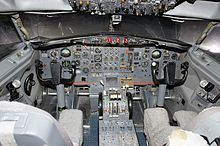
The olfactory organ gear steering-wheel (tiller) is visible as a semi-round wheel to the left of the yoke in this photo of a Boeing 727 cockpit
Some shipping link the yoke, command stick, or rudder directly to the wheel used for steering. Manipulating these controls turns the steering cycle (the nose cycle for tricycle landing gear, and the tail wheel for taildraggers). The connection may exist a firm i in which any movement of the controls turns the steering bicycle (and vice versa), or information technology may be a soft one in which a jump-like mechanism twists the steering wheel just does not forcefulness it to plough. The old provides positive steering but makes it easier to skid the steering wheel; the latter provides softer steering (making it piece of cake to overcontrol) merely reduces the probability of skidding. Aircraft with retractable gear may disable the steering mechanism wholly or partially when the gear is retracted.[ citation needed ]
Differential braking [edit]
Differential braking depends on asymmetric application of the brakes on the principal gear wheels to plough the aircraft. For this, the aircraft must be equipped with separate controls for the right and left brakes (ordinarily on the rudder pedals). The nose or tail bike commonly is not equipped with brakes. Differential braking requires considerable skill. In shipping with several methods of steering that include differential braking, differential braking may exist avoided because of the wear it puts on the braking mechanisms. Differential braking has the advantage of being largely independent of any motility or skidding of the nose or tailwheel.[ citation needed ]
Tiller [edit]
A tiller in an shipping is a small-scale cycle or lever, sometimes accessible to one airplane pilot and sometimes duplicated for both pilots, that controls the steering of the aircraft while it is on the basis. The tiller may be designed to work in combination with other controls such as the rudder or yoke. In large airliners, for example, the tiller is frequently used as the sole means of steering during taxi, and then the rudder is used to steer during takeoff and landing, so that both aerodynamic command surfaces and the landing gear tin can exist controlled simultaneously when the shipping is moving at aerodynamic speeds.[ commendation needed ]
Tires and wheels [edit]

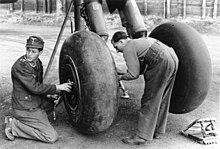
The specified selection criterion, eastward.m., minimum size, weight, or force per unit area, are used to select suitable tires and wheels from manufacturer's catalog and industry standards constitute in the Aircraft Yearbook published by the Tire and Rim Association, Inc.[70]
Gear loading [edit]
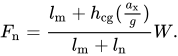
The option of the primary cycle tires is made on the footing of the static loading case. The total main gear load is calculated assuming that the aircraft is taxiing at low speed without braking:[71]

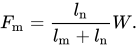
where is the weight of the aircraft and and are the distance measured from the shipping's center of gravity(cg) to the master and nose gear, respectively.


The choice of the nose wheel tires is based on the nose wheel load during braking at maximum effort:[71]


where is the elevator, is the drag, is the thrust, and is the summit of aircraft cg from the static groundline. Typical values for on dry concrete vary from 0.35 for a uncomplicated restriction system to 0.45 for an automatic brake pressure control arrangement. Every bit both and are positive, the maximum nose gear load occurs at low speed. Reverse thrust decreases the nose gear load, and hence the status results in the maximum value:[71]


To ensure that the rated loads will non be exceeded in the static and braking conditions, a seven percent safety factor is used in the calculation of the applied loads.
Aggrandizement pressure [edit]
Provided that the cycle load and configuration of the landing gear remain unchanged, the weight and volume of the tire will decrease with an increase in aggrandizement pressure.[71] From the flotation standpoint, a decrease in the tire contact surface area volition induce a higher begetting stress on the pavement which may reduce the number of airfields available to the shipping. Braking will also get less effective due to a reduction in the frictional force between the tires and the footing. In addition, the decrease in the size of the tire, and hence the size of the wheel, could pose a trouble if internal brakes are to be fitted inside the cycle rims. The arguments confronting higher pressure are of such a nature that commercial operators more often than not prefer the lower pressures in order to maximize tire life and minimize runway stress. To prevent punctures from stones Philippine Airlines had to operate their Hawker Siddeley 748 aircraft with pressures as low every bit the tire manufacturer would allow.[72] Yet, too low a pressure tin lead to an accident as in the Nigeria Airways Flight 2120.
A rough general rule for required tire force per unit area is given past the manufacturer in their catalog. Goodyear for case advises the pressure to be 4% higher than required for a given weight or as fraction of the rated static load and inflation.[73]
Tires of many commercial aircraft are required to be filled with nitrogen, and not subsequently diluted with more than v% oxygen, to preclude machine-ignition of the gas which may event from overheating brakes producing volatile vapors from the tire lining.[74]
Naval aircraft use dissimilar pressures when operating from a carrier and ashore. For example, the Northrop Grumman E-two Hawkeye tire pressures are 260 psi on ship and 210 psi ashore.[75] En-road deflation is used in the Lockheed C-5 Milky way to suit airfield conditions at the destination but adds excessive complexity to the landing gear and wheels[76]
Futurity developments [edit]
Airport community noise is an environmental issue which has brought into focus the contribution of aerodynamic noise from the landing gear. A NASA long-term goal is to confine shipping objectional noise to within the airport boundary. During the approach to land the landing gear is lowered several miles from touchdown and the landing gear is the dominant airframe noise source, followed by deployed highlift devices. With engines at a reduced power setting on the approach it is necessary to reduce airframe noise to brand a meaning reduction to total aircraft noise.[77] [78] The add-on of add-on fairings is one arroyo for reducing the racket from the landing gear with a longer term approach to accost noise generation during initial pattern.[79]
Airline specifications require an airliner to reach upward to 90,000 take-offs and landings and coil 500,000 km on the ground in its lifetime. Conventional landing gear is designed to absorb the energy of a landing and doesn't perform well at reducing basis-induced vibrations in the airframe during landing basis curl, taxi and take-off. Airframe vibrations and fatigue damage tin can be reduced using semi-active oleos which vary damping over a wide range of ground speeds and rail quality.
Accidents [edit]
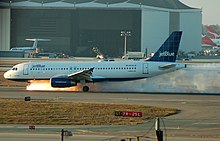
JetBlue Airways Flight 292, an Airbus A320, making an emergency landing on track 25L at Los Angeles International Drome in 2005 after the front landing gear malfunctioned
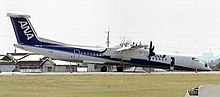
Malfunctions or human errors (or a combination of these) related to retractable landing gear have been the cause of numerous accidents and incidents throughout aviation history. Distraction and preoccupation during the landing sequence played a prominent role in the approximately 100 gear-up landing incidents that occurred each year in the United states of america between 1998 and 2003.[lxxx] A gear-up landing, also known every bit a belly landing, is an accident that results from the pilot forgetting to lower the landing gear, or being unable to practice so because of a malfunction. Although rarely fatal, a gear-up landing tin can be very expensive if it causes extensive airframe/engine damage. For propeller-driven aircraft a prop strike may require an engine overhaul.
Some aircraft have a stiffened fuselage underside or added features to minimize structural damage in a wheels-up landing. When the Cessna Skymaster was converted for a military spotting role (the O-2 Skymaster), fiberglass railings were added to the length of the fuselage; they were adequate to back up the shipping without impairment if it was landed on a grassy surface.[ citation needed ]
The Bombardier Dash viii is notorious for its landing gear bug. There were iii incidents involved, all of them involving Scandinavian Airlines, flights SK1209, SK2478, and SK2867. This led to Scandinavian retiring all of its Dash 8s. The crusade of these incidents was a locking mechanism that failed to work properly. This also caused concern for the shipping for many other airlines that found similar problems, Bombardier Aerospace ordered all Dash 8s with 10,000 or more hours to be grounded, it was shortly establish that 19 Horizon Airlines Dash 8s had locking mechanism problems, so did 8 Austrian Airlines planes, this did cause several hundred flights to be canceled.[ citation needed ]
On September 21, 2005, JetBlue Airways Flight 292 successfully landed with its nose gear turned xc degrees sideways, resulting in a shower of sparks and flame subsequently touchdown.[81]
On November 1, 2011, LOT Polish Airlines Flying LO16 successfully abdomen landed at Warsaw Chopin Airport due to technical failures; all 231 people on board escaped without injury.[82]
Emergency extension systems [edit]
In the event of a failure of the aircraft'due south landing gear extension machinery a backup is provided. This may exist an alternating hydraulic system, a hand-crank, compressed air (nitrogen), pyrotechnic or free-fall arrangement.[83]
A free-fall or gravity drib system uses gravity to deploy the landing gear into the down and locked position. To achieve this the pilot activates a switch or mechanical handle in the cockpit, which releases the up-lock. Gravity then pulls the landing gear down and deploys it. Once in position the landing gear is mechanically locked and safe to use for landing.[84]
Ground resonance in rotorcraft [edit]
Rotorcraft with fully articulated rotors may experience a dangerous and self-perpetuating phenomenon known equally footing resonance, in which the unbalanced rotor system vibrates at a frequency coinciding with the natural frequency of the airframe, causing the entire aircraft to violently shake or wobble in contact with the ground.[85] [86] Basis resonance occurs when shock is continuously transmitted to the turning rotors through the landing gear, causing the angles betwixt the rotor blades to become uneven; this is typically triggered if the aircraft touches the ground with forward or lateral motion, or touches down on i corner of the landing gear due to sloping ground or the craft's flight attitude.[85] [86] The resulting vehement oscillations may crusade the rotors or other parts to catastrophically fail, detach, and/or strike other parts of the airframe; this tin can destroy the shipping in seconds and critically endanger persons unless the pilot immediately initiates a takeoff or closes the throttle and reduces rotor pitch.[85] [86] Ground resonance was cited in 34 National Transportation Safety Board incident and accident reports in the U.s.a. betwixt 1990 and 2008.[85]
Rotorcraft with fully articulated rotors typically have stupor-absorbing landing gear designed to prevent ground resonance; however, poor landing gear maintenance and improperly inflated tires may contribute to the phenomenon.[85] Helicopters with skid-type landing gear are less decumbent to ground resonance than those with wheels.[86]
Stowaways [edit]
Unauthorized passengers accept been known to stowaway on larger aircraft by climbing a landing gear strut and riding in the compartment meant for the wheels. At that place are extreme dangers to this practice, with numerous deaths reported. Dangers include a lack of oxygen at high altitude, temperatures well below freezing, crush injury or death from the gear retracting into its confined space, and falling out of the compartment during takeoff or landing.[87]
Spacecraft [edit]
Launch vehicles [edit]

Falcon 9 descending, simply after landing legs were extended, May 2017.

Landing gear has traditionally not been used on the vast majority of launch vehicles, which accept off vertically and are destroyed on falling back to earth. With some exceptions for suborbital vertical-landing vehicles (e.g., Masten Xoie or the Armadillo Aerospace' Lunar Lander Challenge vehicle), or for spaceplanes that utilise the vertical takeoff, horizontal landing (VTHL) approach (e.g., the Infinite Shuttle orbiter, or the USAF 10-37), landing gear have been largely absent from orbital vehicles during the early decades since the appearance of spaceflight engineering, when orbital space send has been the sectional preserve of national-monopoly governmental infinite programs.[88] Each spaceflight system through 2015 had relied on expendable boosters to begin each ascent to orbital velocity.
Advances during the 2010s in private infinite transport, where new competition to governmental infinite initiatives has emerged, have included the explicit pattern of landing gear into orbital booster rockets. SpaceX has initiated and funded a multimillion-dollar reusable launch system development programme to pursue this objective. As part of this programme, SpaceX built, and flew eight times in 2012–2013, a first-generation test vehicle called Grasshopper with a large stock-still landing gear in order to exam depression-altitude vehicle dynamics and control for vertical landings of a near-empty orbital offset stage.[89] [90] A second-generation exam vehicle called F9R Dev1 was built with extensible landing gear. The prototype was flown 4 times—with all landing attempts successful—in 2014 for low-altitude tests before being cocky-destructed for safety reasons on a fifth test flight due to a blocked engine sensor port.[91] [92]
The orbital-flying version of the test vehicles–Falcon nine and Falcon Heavy—includes a lightweight, deployable landing gear for the booster stage: a nested, telescoping piston on an A-frame. The total span of the four carbon fiber/aluminum extensible landing legs[93] [94] is approximately 18 metres (threescore ft), and counterbalance less than 2,100 kilograms (4,600 lb); the deployment organization uses high-pressure Helium as the working fluid.[95] The first test of the extensible landing gear was successfully accomplished in April 2014 on a Falcon 9 returning from an orbital launch and was the first successful controlled bounding main soft touchdown of a liquid-rocket-engine orbital booster.[96] [97] After a single successful booster recovery in 2015, and several in 2016, the recovery of SpaceX booster stages became routine by 2017. Landing legs had become an ordinary operational part of orbital spaceflight launch vehicles.
The newest launch vehicle under development at SpaceX—the Starship—is expected to have landing legs on its beginning phase chosen Super Heavy[98] like Falcon 9 but also has landing legs on its reusable 2d stage, a first for launch vehicle second stages. The showtime epitome of Starship—Starhopper, built in early 2019—had 3 fixed landing legs with replaceable shock absorbers.[99] In lodge to reduce mass of the flight vehicle and the payload penalisation for a reusable design, the long-term programme is for vertical landing of the Super Heavy to land direct back at the launch site on a special ground equipment that is part of the launch mountain,[98] but initial testing of the large booster in 2020 is expected to occur with landing legs.
Landers [edit]
Spacecraft designed to land safely on extraterrestrial bodies such every bit the Moon or Mars are known as either legged landers (for example the Apollo Lunar Module) or pod landers (for example Mars Pathfinder) depending on their landing gear. Pod landers are designed to land in any orientation after which they may bounce and scroll before coming to rest at which time they take to exist given the correct orientation to function. The whole vehicle is enclosed in crushable cloth or airbags for the impacts and may accept opening petals to right it.[100]
Features for landing and move on the surface were combined in the landing gear for the Mars Science Laboratory.[101]
For landing on low-gravity bodies landing gear may include concord-down thrusters, harpoon anchors and foot-pad screws, all of which were incorporated in the pattern of comet-lander Philae for redundancy.[102] In the instance of Philae, nevertheless, both harpoons and the agree-downwardly thruster failed, resulting in the craft billowy before landing for good at a non-optimal orientation.[103]
-

Apollo Lunar Module showing landing gear legs
-

The Mars Pathfinder lander during a basis test encased in its cluster of air numberless
-

Comet lander Philae showing anchoring harpoons (ii) and foot-pad screws (3)
-

Mars Scientific discipline Laboratory showing rover'southward wheels which acted equally landing gear for initial touchdown
-

Mars Pathfinder showing ane of 3 petals and deflated airbags
Come across also [edit]
- Dayton-Wright RB-1 Racer, an early case of an plane with retractable landing gear.
- Landing gear extender
- Tundra tire, a depression-pressure landing gear tire assuasive landings on rough surfaces
- Undercarriage arrangements of jetliners and other shipping.
- Verville Racer Aircraft, an early on example of an aeroplane with retractable landing gear.
References [edit]
- ^ The Design Of The Aeroplane, Darrol Stinton 1983, ISBN 0-632-01877-1, p.63
- ^ Farnborough and the Fleet Air Arm, Geoffrey Cooper 2008, ISBN 978 i 85780 306 viii, pp. 197-205
- ^ Power The Pratt and Whitney Canada Story, Kenneth H> Sullivan and Larry Milberry 1989, ISBN 0-921022-01-8, pp. 193/194
- ^ Magnesium Overcast The Story of the Convair B-36, Dennis R. Jenkins2001-2002, ISBN 978-one-58007-129-i, p. 17
- ^ Gerd Roloff (April 2002). "Aircraft Landing Gear" (PDF). Airbus-Deutschland GmbH. The Development of a Arrangement. Archived from the original (PDF) on 2008-11-22. Retrieved 2017-05-23 .
- ^ https://apps.dtic.mil/dtic/tr/fulltext/u2/a105512.pdf, TABLE 1
- ^ http://ftp.demec.ufpr.br/disciplinas/TM240/Marchi/Bibliografia/Hoerner.pdf p.14-iii
- ^ https://soaneemrana.org/onewebmedia/Shipping%20DESIGN%20%3B%20A%20Conceptual%20Approach%20BY%20DANIEL%20P%20RAYMER.pdf Archived 2019-07-04 at the Wayback Motorcar, p.230
- ^ "Aviation Calendar week 1950-09-11". September eleven, 1950 – via Internet Annal.
- ^ AMT Airframe Handbook Volume 2 (FAA-H-8083-31). Washington DC: FAA. pp. 13–24.
- ^ 747 Creating The World's First Colossal Jet And Other Adventures From A Life In Aviation, Joe Sutter 2006, ISBN 0 06 088241 7, p. 129
- ^ Sengfelder, Günther (1993). German Aircraft Landing Gear. Atglen, PA The states: Schiffer Publishing. pp. 40–42. ISBN0-88740-470-7.
A significant advantage of this [Ar 232] aircraft was its rough-field landing gear. With the landing gear in the compressed position, the 11 pairs of wheels mounted on independently-sprung legs beneath the fuselage, together with the wide-track main landing gear (8.four meter, 27 ft vi in wheel rail) and the levered-pause olfactory organ wheel, gave the shipping outstanding rough field capabilities.
- ^ Magnesium Clouded The Story of the Convair B-36, Dennis R. Jenkins 2001-2002, ISBN ane 58007 042 6, pp. 14/15
- ^ Egbert Torenbeek (1976), Synthesis of Subsonic Airplane Design, Delft Academy Press, Fig. 10-5
- ^ Airbus A340 And A330, Guy Norris and Mark Wagner 2001, ISBN 0 7603 0889 6, p.29
- ^ Civil Aircraft In Colour, Hiroshi Seo 1984, ISBN 0 7106 0346 0, p. 11
- ^ Airbus A380 Superjumbo Of The 21 St Century, Guy Norris ans Marker Wagner 2010, ISBN 978 0 7603 3838 4, p. 135
- ^ Tarantola, Andrew. "The Globe's Largest Cargo Aeroplane Can Swallow a 737 Whole". gizmodo.com.
- ^ "A321 shipping characteristics" (PDF). Airbus. April 2020.
- ^ "A350 aircraft characteristics" (PDF). Airbus. May 2020.
- ^ "svenska flygmotor | combat biplane | viggen | 1967 | 0650 | Flying Archive". flightglobal.com. 1967. Retrieved 22 November 2019.
- ^ "de havilland | 1961 | 0430 | Flight Archive".
- ^ Havens, Robert F. (April 1, 1945). "Tank tests of a flying-boat model equipped with several types of fairing designed to reduce the air elevate of the main footstep" (PDF) – via ntrs.nasa.gov.
- ^ Ferguson, J. A.; Seibels, R. E.; Corber, R. J. (September 1, 1949). "Flight tests of the hydrodynamic characteristics of a Japanese "Emily" flying boat" – via ntrs.nasa.gov.
- ^ https://ntrs.nasa.gov/archive/nasa/casi.ntrs.nasa.gov/19930093610.pdf, p.25
- ^ https://apps.dtic.mil/dtic/tr/fulltext/u2/650769.pdf
- ^ a b "Aviation Week 1952-06-23". June 23, 1952 – via Net Archive.
- ^ https://www.scribd.com/document/169396592/Is-There-a-Part-for-Mod-Day-Seaplanes-in-Open up-Ocean-Search-and-Rescue-pdf, p.35
- ^ https://apps.dtic.mil/dtic/tr/fulltext/u2/a476447.pdf, p.13
- ^ https://archive.org/details/DTIC_ADA476447 p.xiii
- ^ Goebel, Greg (1 April 2021). "Beriev A-40, Be-200, & Be-103 Flying Boats". airvectors.net. Archived from the original on 22 Jan 2022. Retrieved 5 Feb 2022.
- ^ https://calhoun.nps.edu/handle/10945/14093, p.4
- ^ https://ntrs.nasa.gov/annal/nasa/casi.ntrs.nasa.gov/19930083200.pdf, Figure 3 (d)
- ^ "Aircraft landing gear".
- ^ https://www.biodiversitylibrary.org/bibliography/38156#/summary, p.189
- ^ Fisher, Lloyd J. (April 25, 1950). "Model ditching investigations of three airplanes equipped with hydro-skis" – via ntrs.nasa.gov.
- ^ "1971 | 0062 | Flying Annal".
- ^ ""Ski Leap" Harrier". FLIGHT International: 1630–1635. 4 December 1976.
- ^ "New life for lynx". Flightglobal.com. July xvi, 2002.
- ^ Tupolev Tu-22 Blinder, Sergey Burdin & Alan E Dawes2006, ISBN 1 84415 241 3, p.71
- ^ The 10-Planes X-one To X-31, Jay Miller 1988, ISBN 0 517 56749 0, p.169 and 190
- ^ Canada Aviation and Space Museum (northward.d.). "Messerschmitt Me 163B-1a Komet". Retrieved 13 May 2012.
- ^ "Aerostories: Arado 234, July - August 1944: no ordinary missions." Aerostories. Retrieved: 16 March 2016.
- ^ Sengfelder, Günther (1993). German Aircraft Landing Gear. Atglen, PA USA: Schiffer Publishing. pp. 141–142. ISBN0-88740-470-7.
During retraction the nosewheel had to turn through 90 degrees, which was achieved past means of a mechanism in the head of the bicycle fork. On retraction, a spring-loaded level with pulley, which express deflection to sixty degrees by means of a locking claw and stop, was folded into the fuselage and turned through xc degrees after making contact with a guide.
- ^ U.S. Naval Air Superiority Development Of Shipborne Jet Fighters 1943-1962, Tommy H. Thomason 2007, ISBN 978 one 58007 110 9, p.106/107
- ^ Dow, Andrew (February 19, 2015). Pegasus: The Center of the Harrier (two ed.). Pen and Sword. p. 312. ISBN978-ane-84884-042-three.
- ^ Air Force Legends Number 201 The Martin XB-51, Scott Libis, 1998, ISBN 0 942612 00 0, p. 2
- ^ The B-47. Lookout Mountain Air Force Station. 1950.
- ^ Flying American Combat Aircraft The Cold War, Edited past Robin Higham 2005, ISBN 978 0 8117 3238 iii, p.32
- ^ http://world wide web.air.flyingway.com/books/Airframe-Stuctural-Design.pdf p.436
- ^ Sengfelder, Günther (1993). German language Aircraft Landing Gear. Atglen, PA USA: Schiffer Publishing. pp. forty–42. ISBN0-88740-470-vii.
A pregnant advantage of this [Ar 232] aircraft was its rough-field landing gear. With the landing gear in the compressed position, the eleven pairs of wheels mounted on independently-sprung legs beneath the fuselage, together with the wide-track main landing gear (eight.4 meter, 27 ft half dozen in wheel track) and the levered-suspension nose wheel, endowed the shipping with outstanding rough field capabilities.
- ^ "North American NA-141 Fury (FJ-1)". Yanks Air Museum. Archived from the original on 18 Dec 2015. Retrieved 23 January 2016.
- ^ Mesko, Jim (2002). FH Phantom/F2H Banshee in action. Carrollton, Texas, USA: Squadron/Indicate Publications, Inc. p. 12. ISBN0-89747-444-9.
- ^ http://world wide web.air.flyingway.com/books/Airframe-Stuctural-Pattern.pdf, p. 435
- ^ http://everyspec.com/MIL-STD/MIL-STD-1700-1799/MIL-STD-1791C_55770/ FIGURE B-6
- ^ http://www.air.flyingway.com/books/Airframe-Stuctural-Design.pdf, pp. 432, 434
- ^ Jane's All The World's Aircraft 1982–83, John W.R. Taylor, ISBN 0 7106 0748 2, p. 394
- ^ http://www.dept.aoe.vt.edu/~mason/Mason_f/M96SC01.pdf
- ^ http://everyspec.com/MIL-SPECS/MIL-SPECS-MIL-L/MIL-L-87139_8546/ p.31
- ^ http://everyspec.com/MIL-STD/MIL-STD-1700-1799/MIL-STD-1791C_55770/ TABLE III, Figure B-71 and B-95
- ^ "Europa XS Monowheel Overview". Europa Aircraft Ltd. 2011. Archived from the original on 5 December 2008. Retrieved thirteen May 2012.
- ^ Cox, Taylor. "Skids or Wheels?". helis.com . Retrieved 3 March 2018.
- ^ "Ju288の脚". www5a.biglobe.ne.jp.
- ^ Sengfelder, Günther (1993). German Aircraft Landing Gear. Atglen, PA U.s.a.: Schiffer Publishing. pp. 175–177. ISBN0-88740-470-seven.
The Ju 288's landing gear was most innovative in its design. A Y-shaped bearer was mounted in the engine nacelle with its upper arms hinged. At the lesser end of this bearer was the stupor absorber leg, which was likewise hinged. Ii double-brake wheels, with (metric) size 1015 x 380 tires, were mounted on the cantankerous-axle. During the retraction cycle a folding strut was raised by a hydraulic jack. The bottom role of the folding strut drew the Y-bearer upwardly. Functioning via a lever-and-gear organisation, a pushrod positioned parallel to the Y-bearer acted upon another gear segment mounted to the oleo leg's hinge pin and rotated it about this as the Y-bearer was drawn upwards.
- ^ https://www.flightglobal.com/pdfarchive/view/1943/1943 - 2372.html
- ^ https://www.flightglobal.com/pdfarchive/view/1971/1971 - 2630.html
- ^ Magnesium Overcast The Story of the Convair B-36, Dennis R. Jenkins 2001-2002, ISBN 978 ane 58007 129 i, p.17
- ^ "History of Aircraft Runway Landing Gear". Air Force Materiel Command.
- ^ International Air Ship Association (June 2014). "Technology Roadmap" (PDF). iata.org. Archived from the original (PDF) on 14 May 2014. Retrieved 28 February 2022.
- ^ https://ntrs.nasa.gov/annal/nasa/casi.ntrs.nasa.gov/19970031272.pdf, p.xxx
- ^ a b c d Chai, Sonny T.; Mason, William H. (September 1, 1996). Landing Gear Integration in Aircraft Conceptual Design (PDF). NASA CR-205551. Vol. MAD 96-09-01 (revised March 1, 1997 ed.). Blacksburg, Virginia: Virginia Polytechnic Found and State University. OCLC 39005288. Retrieved 25 October 2018 – via NASA.
- ^ "Test Pilot" Tony Blackman, Grub Street Publishing 2009, ISBN 9781906502362, p.177
- ^ [1] Goodyear Tire & Rubber Co., Retrieved: 26 January 2012.
- ^ [2] FAA Ruling: "Use of Nitrogen or Other Inert Gas for Tire inflation in Lieu of Air" Docket No. 26147 Amendment No. 25-78 RIN 2120-AD87
- ^ Jane'south All The World'southward Aircraft 1982-1983, Edited by John W. R. Taylor, ISBN 0 86720 621 vii, p.376
- ^ MIL87139, p.24
- ^ http://digitool.library.mcgill.ca/webclient/StreamGate?folder_id=0&dvs=1575683504592~592, p.5
- ^ Powell, Clemans A.; Preisser, John Due south. (January 2000). "NASA's Subsonic Jet Send Noise Reduction Research" (PDF).
- ^ http://resource.isvr.soton.ac.united kingdom/staff/pubs/PubPDFs/Pub12391.pdf
- ^ The Office of the NASA Aviation Safe Reporting System (Jan 2004). "Gear Up Checkup" (PDF). Call Back ASRS. NASA (292). Retrieved 1 April 2012.
- ^ https://world wide web.ntsb.gov/_layouts/ntsb.aviation/brief2.aspx?ev_id=20050927X01540&ntsbno=LAX05IA312&akey=1
- ^ Scislowska, Monika (three Nov 2011). "Warsaw airport back to work subsequently plane emergency". NBC News . Retrieved xiii January 2012.
- ^ "Boeing 757 Landing Gear". Biggles Software. 29 December 2011. Archived from the original on 24 March 2009. Retrieved 13 May 2012.
- ^ Stellan F. Hilmerby (24 November 2009). "Landing Gear". Stellans Flightsim Pages . Retrieved xiii May 2012.
- ^ a b c d east Garrison, Peter (December 2008). "How Things Work: Ground Resonance". airspacemag.com. Air and Space Magazine. Retrieved 6 November 2018.
- ^ a b c d "Rotorcraft Flying Handbook" (PDF). faa.gov. Federal Aviation Assistants. 2000. pp. 11–vii. Retrieved 6 November 2018.
- ^ "Wheel-well Stowaways Adventure Lethal Levels of Hypoxia and Hypothermia" (PDF). Flight Safe Foundation. May–June 1997. Retrieved 15 June 2015.
- ^ Hanlon, Michael (2013-06-11). "Roll up for the Ruby Planet". The Telegraph. Archived from the original on 2013-06-12. Retrieved 2013-10-26 .
the infinite race is flaring back into life, and it'south not massive institutions such as Nasa that are in the running. The old view that homo space flight is so circuitous, hard and expensive that merely huge government agencies could promise to reach information technology is being disproved past a new brood of flamboyant space privateers, who are planning to send humans out across the Globe's orbit for the first fourth dimension since 1972.
- ^ Foust, Jeff (2013-ten-xviii). "SpaceX wrapping up Falcon 9 second stage investigation every bit it moves on from Grasshopper". NewSpace Journal . Retrieved 2013-10-26 .
- ^ Klotz, Irene (2013-10-17). "SpaceX Retires Grasshopper, New Exam Rig To Fly in December". Space News. Archived from the original on October 21, 2013. Retrieved 2013-10-26 .
- ^ Foust, Jeff (2014-08-23). "Falcon ix test vehicle destroyed in accident". NewSpace Journal. Retrieved 2014-08-23 .
- ^ Leone, Dan (2013-05-13). "SpaceX Leases Pad in New Mexico for Next Grasshopper Tests". SpaceNews. Archived from the original on September 3, 2013. Retrieved 2013-08-03 .
- ^ "Landing Legs". SpaceX News. 2013-07-29. Retrieved 2013-07-xxx .
The Falcon nine first phase carries landing legs which will deploy after phase separation and allow for the rocket'southward soft return to Globe. The four legs are made of state-of-the-art carbon fiber with aluminum honeycomb. Placed symmetrically around the base of the rocket, they stow along the side of the vehicle during liftoff and later extend outward and downwardly for landing.
- ^ "Landing Legs". SpaceX News. 2013-04-12. Retrieved 2013-08-02 .
The Falcon Heavy start stage middle core and boosters each carry landing legs, which will state each core safely on Earth later on takeoff. Afterwards the side boosters separate, the centre engine in each will burn to control the booster's trajectory safely away from the rocket. The legs will then deploy as the boosters turn back to Earth, landing each softly on the footing. The eye core will proceed to fire until stage separation, after which its legs will deploy and land it dorsum on Earth too. The landing legs are made of land-of-the-art carbon cobweb with aluminum honeycomb. The four legs stow along the sides of each core during liftoff and later extend outward and down for landing.
- ^ Lindsey, Clark (2013-05-02). "SpaceX shows a leg for the "F-niner"" . Retrieved 2013-05-02 .
F9R (pronounced F-niner) shows a piffling leg. Blueprint is a nested, telescoping piston w A frame... High pressure helium. Needs to be ultra lite.
- ^ Belfiore, Michael (Apr 22, 2014). "SpaceX Brings a Booster Safely Dorsum to Earth". MIT Technology Review . Retrieved April 25, 2014.
- ^ Norris, Guy (Apr 28, 2014). "SpaceX Plans For Multiple Reusable Booster Tests". Aviation Week . Retrieved April 27, 2014.
The April 17 F9R Dev 1 flying, which lasted under one min., was the kickoff vertical landing test of a production-representative recoverable Falcon nine v1.1 kickoff stage, while the Apr 18 cargo flight to the ISS was the start opportunity for SpaceX to evaluate the design of foldable landing legs and upgraded thrusters that command the stage during its initial descent.
- ^ a b Musk, Elon (1 March 2018). "Making Life Multi-Planetary". New Infinite. 6 (1): ii–xi. Bibcode:2018NewSp...6....2M. doi:10.1089/space.2018.29013.emu.
- ^ Baylor, Michael (ii June 2019). "SpaceX readying Starhopper for hops in Texas as Pad 39A plans materialize in Florida". NASASpaceFlight.com . Retrieved 3 June 2019.
- ^ https://www.cambridge.org/core/books/planetary-landers-and-entry-probes/8DE95EEE4A7A3EF7820792504AC1C5E2, pp.72,74,75,147
- ^ https://www.cambridge.org/cadre/books/planetary-landers-and-entry-probes/8DE95EEE4A7A3EF7820792504AC1C5E2, p.76
- ^ https://www.cambridge.org/core/books/planetary-landers-and-entry-probes/8DE95EEE4A7A3EF7820792504AC1C5E2, Chapter 26
- ^ "Problems hit Philae after celebrated offset comet landing".
External links [edit]
- "Standard Naming Convention for Aircraft Landing Gear Configurations" (PDF). FAA. October half dozen, 2005.
- How to modify the landing gear of an Airbus A380 (YouTube). Emirates Airline. May 28, 2018. Archived from the original on 2021-11-08.
complete replacement of landing gear systems
- Scholz, Dieter. "Summary: Shipping Pattern in a Nutshell" (PDF). Aircraft Design: Lecture Notes. Hamburg, Deutschland: Hamburg Open up Online University (HOOU). pp. nineteen–20. Retrieved 2 November 2018.
- Al-Hussaini, A.A. (2014–2015). "5: Undercarriage (Landing Gear) Layout Blueprint" (PDF). Aircraft Design. University of Technology, Iraq: Mechanical Department/Aeronautical Branch. Retrieved 14 November 2018.
- "Aircraft Systems: Aircraft Wheels". AeroSavvy. Oct 8, 2019.
DOWNLOAD HERE
Posted by: millercancer.blogspot.com

Post a Comment for "Making Perfect Landings In Light Airplanes Pdf Download UPDATED"